Designops • internal management
Design System for Destácame
Creation of a Design System that improved consistency, accelerated product delivery, and strengthened collaboration between teams.
01
Context
What if the team could stop rebuilding the same elements and focus more on research, validation, and better product decisions?
02
The challenge
Create an official component library from scratch.
Define which elements should be prioritized first.
Improve consistency across web and app experiences.
Reduce duplicated design and development effort.
Strengthen collaboration between UX and frontend teams.
Position the Design System as a core product capability within the organization.
The goal was not just to create a library of UI elements, but to build a shared system that could improve how teams design, build, and evolve digital products.
03
What I did
I led the creation of the Design System from its early stages, working closely with the UX team and collaborating with frontend to align design decisions with implementation needs.
The process started with an internal prioritization exercise, where we identified the components and elements most frequently used across different product flows.
This allowed us to define the first version of the system based on real team needs, instead of trying to document everything at once.
I worked on:
- Component prioritization
- Visual foundations
- Reusable UI elements
- Design documentation
- Team alignment activities
- Collaboration rituals with frontend
- Design System adoption across the organization
04
Defining the system
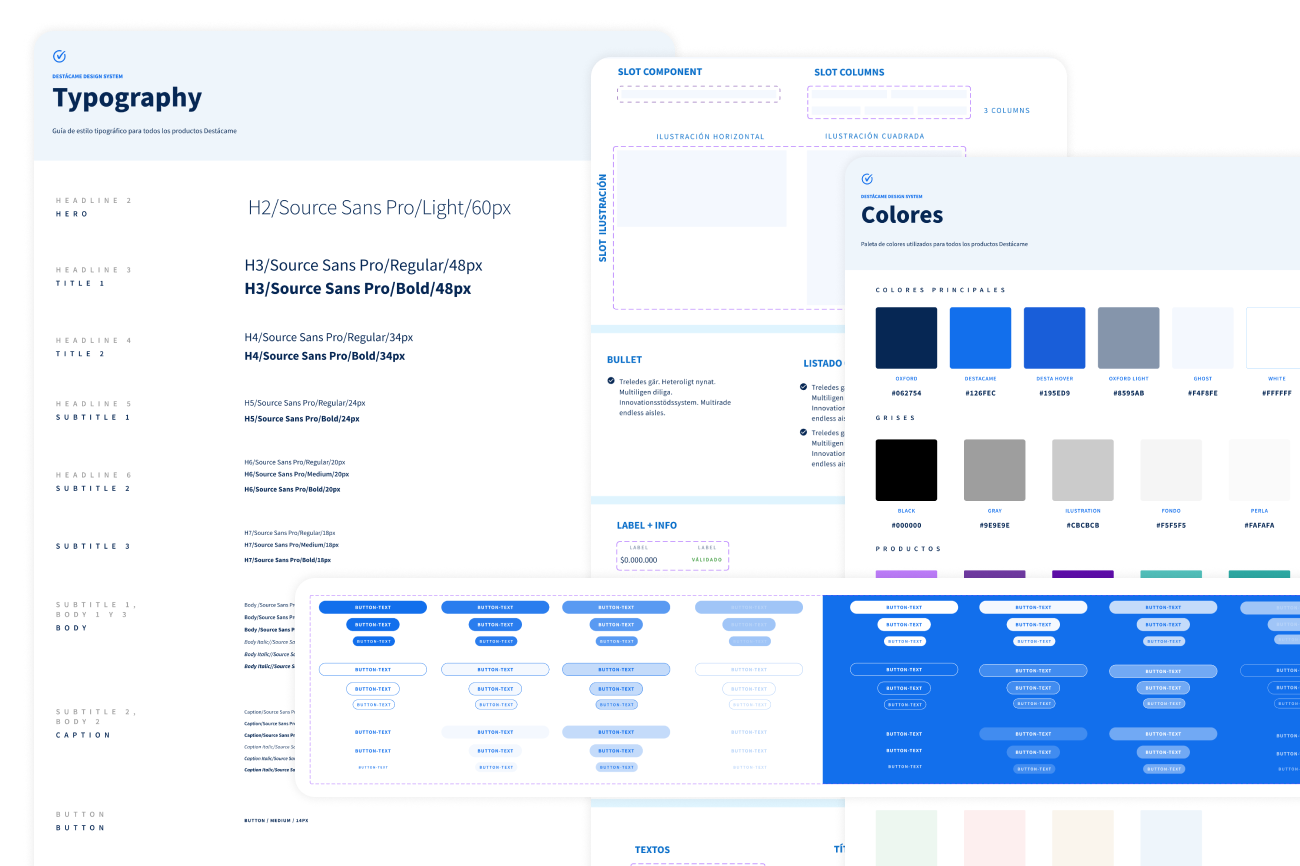
The Design System was structured around four main Figma libraries, enabled by default across new organizational files.
Base
Colors, typography, file covers, logos, and foundational visual elements.
Components
Reusable elements and components, including atoms and molecules used across different flows.
Organisms
Larger interface patterns and recurring screen structures used as starting points for product experiences.
Icons
Material icons, linear and solid icon sets, and illustrative icons for different interface needs.
This structure allowed the team to separate foundations, components, complex patterns, and iconography, making the system easier to maintain and scale.
05
Core tool
A key part of the project was positioning the Design System as a core capability, not just as a design file.
To achieve this, it was important to demonstrate how the system could reduce time spent on repetitive work, improve consistency, and support better collaboration between design and development.
We established weekly working sessions with frontend to review components, improve handoff, and ensure that what was designed in Figma could be implemented efficiently.
This helped the Design System become a shared language between disciplines.
06
Impacto
The Design System helped the team move faster and work with greater consistency.
It contributed to:
- More consistent digital experiences
- Faster design production
- Better communication with frontend
- Reduced duplicated effort
- More scalable product design workflows
- A clearer shared language between teams
It also supported more accessible and understandable product experiences, especially for users less familiar with digital tools.
The value of the system was not only in the components themselves, but in how it improved the way the team worked together.
07
Learnings
This project reinforced that a Design System is not just a technical or visual artifact, but a product in itself.
Its success depends on adoption, collaboration, maintenance, and the ability to demonstrate its value within the organization.
Building the system required design craft, but also facilitation, prioritization, communication, and organizational alignment.
It became one of the most meaningful projects in my career because it showed how design can improve not only the user experience, but also the experience of the teams building the product.
A good Design System does not only make interfaces more consistent. It helps teams make better decisions, reduce friction, and build better products together.
Designing a scalable system to improve consistency, collaboration, and product delivery across web and app experiences.