strategy · ai & AGENT EXPERIENCE
Orchestration agent
Design of the vision, architecture and experience of the CoE of Engineering agent for Cencosud’s IT management.
01
Context
As organizations grow, so does the amount of information they generate. Documentation, research, product definitions, strategic decisions, processes, meetings and learnings end up distributed across multiple tools and teams.
In almost every organization I’ve worked in, the same pattern repeats: the information exists, the documents exist, the decisions are recorded somewhere but finding the right thing at the right moment is still a daily problem.
And often, that knowledge walks out the door with one person.
This isn’t just a productivity problem, It’s an information security problem.
What if something existed that could connect people, knowledge and processes with traceability, and in much less time?
02
The challenge
Accessing relevant information when and where it's needed.
Understanding the context behind past decisions.
Reducing dependency on specific people.
Reusing existing learnings.
Accelerating discovery and decision-making processes.
The challenge wasn’t to create more documentation, but to improve the way people interact with the knowledge that already exists.
03
What i did
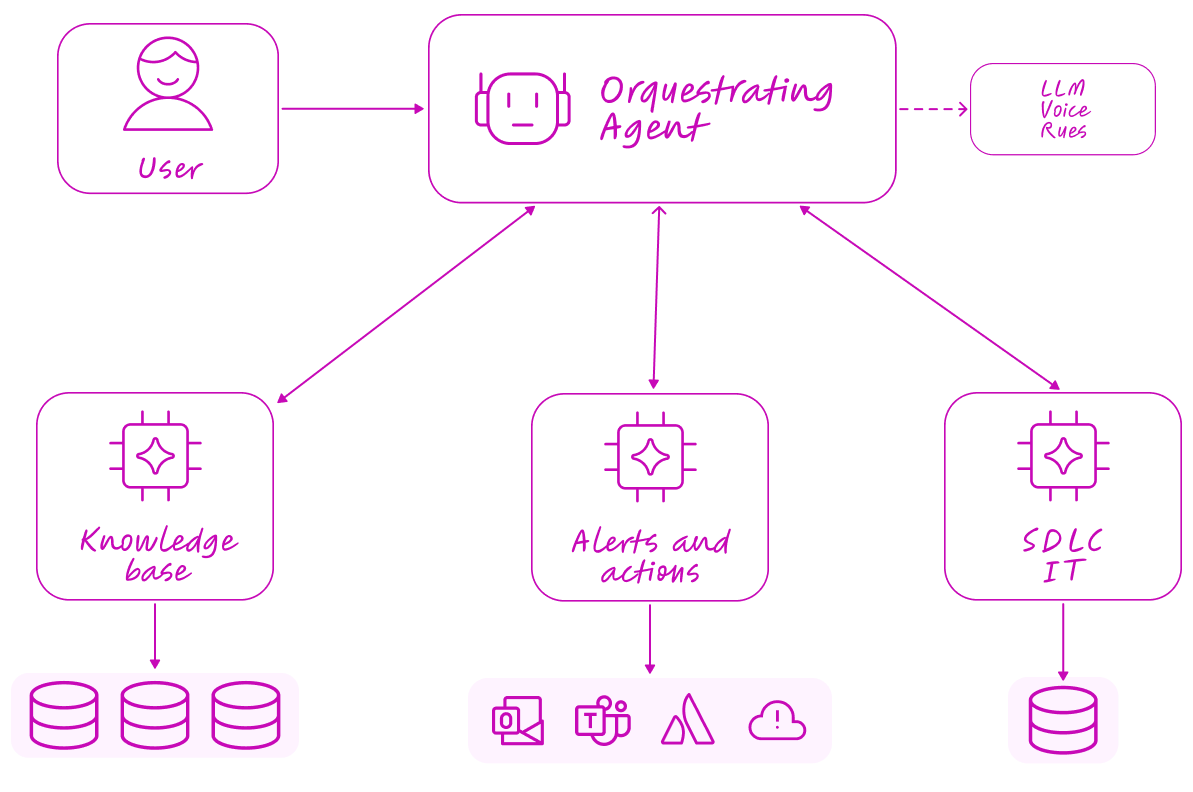
I led the complete conceptualization: purpose, scope, use cases, conversational and agentic experience. I worked with design, product, engineering and operations to build the agent in Microsoft Copilot Studio.
04
Definition of the experience
Instead of approaching the challenge from a traditional interface, I explored how people could interact with systems capable of understanding context and retrieving relevant information. This led me to work in what is now known as Agent Experience (AX) focused on designing interactions between people and intelligent agents.
- What information should the system know?
- How to build trust in its responses?
- How to explain the source of information?
- How to reduce friction without losing control?
- What tasks should remain human?
- How is knowledge coordinated from different sources?
05
Use cases
Project context
Historical information, objectives, decisions, stakeholders and initiative evolution.
Research and discovery
Previous learnings, validations, insights and available evidence.
Processes and ways of working
Practices, methodologies and team collaboration mechanisms.
Functional and technical documentation
Knowledge associated with systems, products and operations.
06
Learnings
The real challenge wasn’t building a smarter agent, but designing a system capable of coordinating different sources of knowledge. Orchestration becomes as important as the intelligence itself. In many cases, the value isn’t generating new responses, but correctly connecting existing information and presenting it at the right moment.