strategic design • ux governance
Operational Platform Regionalization
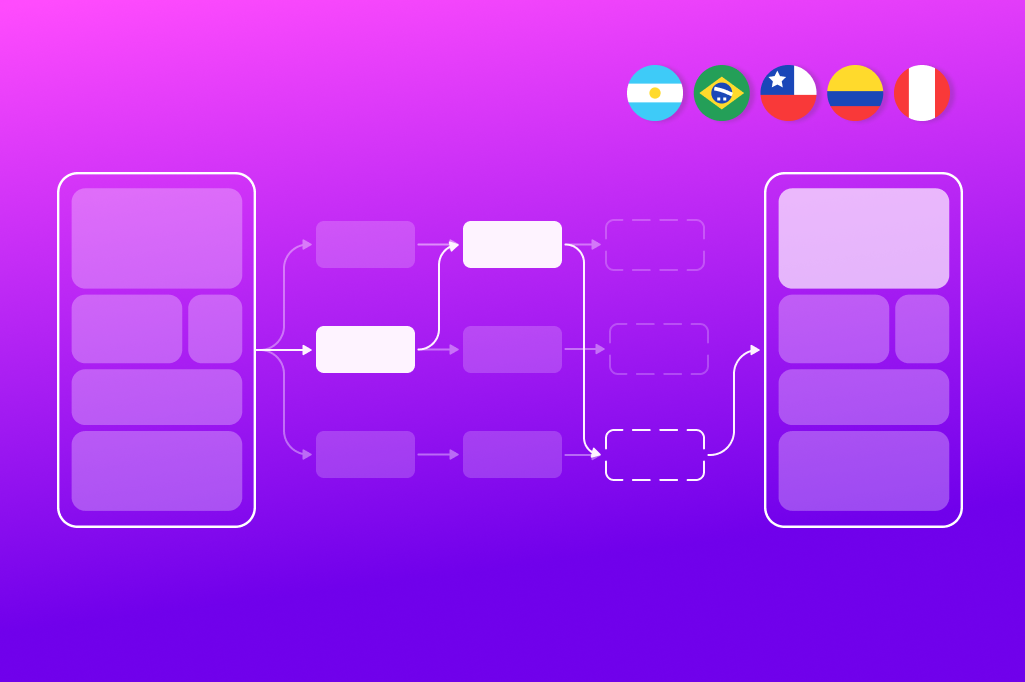
One product, five countries, one question: what should be common and what should stay local?
01
Context
Within Cencosud, teams worked with an internal platform created to improve store operations, with regional reach. Not just an app, an operational ecosystem used by different business units and countries.
As the platform grew, each country and business unit resolved its own needs in isolation. This generated a constant tension: the same digital capability looked and worked differently depending on the country — even within the same business unit.
5
countries
Argentina, Brazil, Colombia, Chile and Perú
3
business units
Supermarket, Home improvements y Department Stores
4
functionalities
Prioritized to pilot the model
02
The challenge
Creating a more orderly, scalable and governable way to evolve the platform at a regional level.
What should be common across the entire region, what could be adapted locally and under what conditions
The problem was that each country and business unit had different needs, processes, speeds, technical maturity and priorities. Without a shared model, there was a risk of ending up with multiple versions of the platform: difficult and expensive to maintain, with low reuse and greater technical debt.
03
The main issue
Find the balance where every point solves something real and sacrifices something real.
Regionalize to scale
Consistency, efficiency and reuse for an increased risk of imposing a single model without considering operational, cultural differences.
vs.
Adapt to local
rom UX, the approach was pragmatic. More than defining an extreme, it was about setting a specific criteria for each decision:
Not everything should be regional.
Not everything local is justified.
The decision should be based on operation, regulation, culture, data, technical feasibility and business value.
04
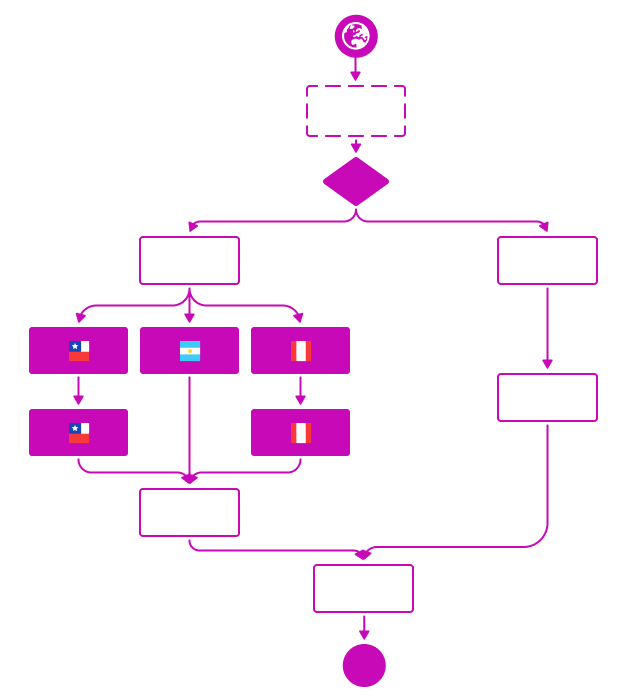
Regional or local decision framework
To facilitate the decision, we defined what types of elements are repeated regionally and what is more effectively addressed locally.
regional
- Core flow
- Common patterns
- Reusable components
- Cross-cutting capabilities
- Design System y standards
- Core integrations
Local
- Specific regulations
- Operational particularities
- Validated cultural differences
- Concrete local priority
- Country-specific adaptations
- Exceptional flows
06
What I did
My role was not limited to interface design. It was a strategic, systemic and articulating role between business, product, technology and operations. In total, my work involved:
Information gathering across countries and business units
Analysis of existing functionalities and identification of common digital capabilities
Definition of criteria for regionalizing or localizing
Alignment with Product, Technology and regional stakeholders
Documentation of flows by country and business unit
06
Deliverables and artifacts
Regional functionality map
Matrix that crosses functionalities and digital capabilities by country and business unit.
Regional analysis base
Structure to organize what exists, where it exists, what is common, what is particular and what can scale.
Regional / local criteria
Decision framework to determine whether a functionality should be treated as a regional standard or local adaptation.
Country research
Specific information gathering by country to understand processes, operational differences and names of existing functionalities in each market.
Designing for five countries is designing for five different realities.
Empathizing, listening and working as a team is vital.